Showing posts with label primary triad. Show all posts

Wednesday, July 16, 2025

A Little Color Before Shopping


7/14/25 Bryant neighborhood

When I’m short on time on a grocery day, but I want to sketch (like there’s ever a time when I don’t want to sketch?), I go to Metro Market. Before shopping, I walk just a few steps to a tiny pocket park next to the Burke-Gilman Trail. Tall trees keep the few benches and tables shady but let narrow streams of light in from the trail side. A few minutes with my Caran d’Ache Neocolor II crayons, and I’m ready to hit the food shelves.

Tuesday, April 29, 2025

Cold Chairs at U Village


4/27/25 University Village

University Village is one of USk Seattle’s tried-and-true for transitional seasons because the retail center has some sheltered areas to keep us dry. Sketchers can make themselves comfy at all the public umbrella’d tables without having to patronize venues. Except for stores and restaurants, however, U Village is all outdoors, so a cold morning is still a cold morning – made even colder because the chairs are made of metal. Yikes! Although I typically stand to sketch anyway, I sat just for a moment to keep my lettering straight, and yowza, was that chair chilly! Despite that common complaint, everyone’s enthusiasm was high last Sunday.

Trying to study color temperature again, I was in the mood for a primary triad to capture the bright colors of red umbrellas and new, green leaves on the Japanese maple trees (plus a U Village icon, Leo Sewell’s “junk” penguin sculpture).

Colder than ever from standing longer than I expected (color temperature studies always take me longer than I think they will), I took a brisk walk around the Village. Finding a spot in the direct sun (if the sun were to appear from behind clouds), I looked around and found bronze sculptures of a calf and a turtle. To add to the menagerie, I caught a living, breathing pup waiting for his human to finish snacking.


Technical note: In the first sketch, I was so focused on the challenge of color temperature combined with using a primary triad (a decision I made before realizing that the scene had so much green) that I really let the composition get away from me. The penguin was so much fun that I started drawing it first, but later I felt that it weakened the composition. Below is how I would have cropped it if I had been thinking more about composition and not about color. As usual, my pea brain can’t handle more than one concept at a time!


Thursday, March 6, 2025

Ramping Up Color Temperature (Plus Thoughts on Colored Pencils)


3/1/25 Rainbow of hues without crossing the color wheel
(all exercises done with Prismacolors in Stillman & Birn
Zeta sketchbook; same Earthsworld reference photo for all)
Week 4’s assignments in Sarah Bixler’s class extended the palette to primary triads and a full rainbow. For the rainbow exercise, we were instructed to avoid blending “across the color wheel” (to create neutrals) and instead maintain fully saturated hues as much as possible, blending only analogously. The result would enable us to demonstrate our understanding of color temperature without neutrals muddying things up. Although the resulting portrait is wacky looking (at left), it certainly was effective in forcing me not to fudge!

For the other two portraits, we were to use a traditional painter’s primary triad and what Sarah calls a printer’s primary triad (what I refer to as CYMK). These were much easier for me because of all the primary triads I had played with a few years ago (and still find fascinating to explore).


3/2/25 printer's primary triad (CYMK)

On one of them, we could add a warm neutral and a cool neutral to help with values if needed (below). I thought the latter additions would be helpful, but in practice, I regretting losing the clarity of the triad hues.

3/3/25 painter's traditional primary triad with addition of indigo and
burnt sienna as cool/warm neutrals

Why use colored pencils?

During a class discussion, one student, a painter, asked sort of a devil’s advocate question: Why use colored pencils instead of paint? Sarah’s response was especially interesting to me as both a colored pencil geek and an urban sketcher: Initially she had started using colored pencils because she was looking for a portable medium that she could use when she was out biking or hiking and wanted to stop for a quick plein air study.

The more she used them, however, the more she realized that colored pencils had unique properties that paint did not. With paints, she can mix any color she wants, but the more she mixes, the less her original chosen palette is apparent. Colored pencils make it easier for her to see how each color addition affects how she perceives the other hues. Because transparent pencils mix optically and can’t blend completely as paint can, they won’t lose their original color identity.

She also finds that because the earlier marks cannot be completely obscured by later layers, she has more opportunity to push toward abstraction. “A nice wonky abstraction is possible,” Sarah said. She enjoys the clear, directional marks that pencils make.

Her comments validated many thoughts I’ve had myself but haven’t always articulated about why colored pencils are a unique, compelling medium.

Saturday, December 2, 2023

Messing Around With Viarco ArtGraf Tailor Shape Blocks

Viarco ArtGraf Tailor Shape water-soluble blocks

In my “messing around” series, I use a product new to me that I know little about and then show the evidence of my mess accompanied by a few uninformed opinions. I don’t consider this a product review.

When I started last month’s series of “messing around” posts, my preamble explained that although these products that had recently crossed my radar were all watercolor-resembling products (either in their form factor or in their results), they were not technically watercolors. This final installment (for now – obviously not forever, knowing me) is a product that resembles traditional watercolors the least. It’s also not new to me; in fact, I’ve had it for years but never got around to even dabbling with it until now.

I think I first learned about Viarco ArtGraf Tailor Shape water-soluble blocks when I was in Porto, Portugal, for the 2018 Urban Sketchers Symposium. I was going to say I may have received some in my goodie bag, but I looked back at that post and don’t see them in the photo, so I must have bought a few colors at the symposium trade show.

I do remember distinctly how I received several more: Sometime during the interminable, early-pandemic doldrums, a member of the pencil community who works at Viarco found out that I was a big fan of the company’s ArtGraf water-soluble graphite pencil. We had chatted about pencils and Porto (the factory is a short distance away, and to this day, I kick myself for missing an opportunity to tour it when I was there). Later he surprised me with a gift of several colors (as well as various other forms of the company’s ArtGraf products). Touched by his generosity, I really wanted to use them, but since I had been away from watercolors for many years, I just wasn’t sure how to get into them. The ArtGraf Tailor Shape blocks sadly languished in my studio – until this month.

In addition to not looking anything like traditional watercolor pan paints, they also don’t look like the bars or blocks we’ve seen in other products like Derwent’s Graphitint or Inktense. I refer to them as “blocks” for lack of a noun in its official product name, which seems to be “ArtGraf Tailor Shape” in reference to old-school tailor’s chalk.

I received or purchased most colors open stock, but I bought the trays so that they could be stored and used like sets. The shiny one at upper left is graphite. Who knows what the others are?

This lack of clear identity is stumping many reviewers. As I searched YouTube to see what others were doing with them, the titles of reviews often seemed to ponder what the heck these “tailor shape” things are – pigment-based like watercolor? Dye-based like Inktense? Graphite-based? Chalk-based?

I admit, I did my share of pondering, but ultimately, I decided it’s best to do what I eventually did while messing around with Inktense Blocks: Stop trying to figure out what other products they resemble and just figure out what Tailor Shapes do best. And what they do best is explode with amazingly rich colors!

11/23/23 ArtGraf Tailor Shape blocks in Hahnemuhle Akademie sketchbook

The colors I had originally acquired individually included the traditional primary triad and several earth tones. Although the blue is close to cyan, I wasn’t too fond of the mixes I was getting with the triad (above and below). Once I saw what the material could do, I purchased all the remaining colors (except white). Blick and Amazon both carry most colors, but I ordered directly from Viarco because I also wanted the empty cork trays to store and use the blocks in. (Plus it was just fun to order from Portugal and say hi to my friend in the order note!) In addition to open-stock singles, the blocks can also be purchased in various sets of earth tones, primaries and monochrome.

Swatches in Hahnemuhle Akademie sketchbook. Red, yellow and blue were used in the primary triad.

Primary triad using magenta instead of red 

One of the new colors I got is magenta (mixes shown at left), which makes a much better primary triad, as I suspected it would.

Like Inktense Blocks (oops, I said I wouldn’t compare – oh, well), they are opaque and dry with a matte finish similar to gouache. Also like Inktense Blocks, the wet-in-wet sky I tried looks streaky and flat. Whatever ArtGraf is made of does not flow well like watercolors, even on Hahnemühle paper.

Although the basic primary + green palette can be mixed into decent secondaries and grays, I think where the ArtGraf blocks really shine are in the earthtones. Using a block as if it were a watercolor paint pan, I first tried the monochrome rabbit (below) to get a feel for varying values of the dark brown. This brought to mind the effects I got with the Derwent Tinted Charcoal and Inktense Pan Paints, both of which are quite tolerant of overworking without appearing overworked. Perhaps it’s a paradox: Although none of these products flows well the way watercolors do, that lack of flow gives me more time to poke around clumsily without ruining the results as much. Score!

10/23/23 Dark brown in Hahnemuhle Akademie sketchbook (photo reference)

For the two portraits, I used a variety of techniques: applied with a brush like traditional pan paints; applied dry over wet paper; applied dry to dry paper and then activated like water-soluble pencils. In some parts of the hair in both portraits, I left the material dry. I’m impressed by the deep hues I achieved without much effort.

11/23/23 I used a mix of sanguine, dark brown and sepia for both portraits to get these beautifully rich skin tones. (Earthsworld reference photos)


The Tailor Shape blocks have two drawbacks, especially for urban sketching: They are not at all portable, especially if they are kept in the large cork trays (which have no lid other than the flimsy plastic packaging). If I want to use these on location, I’d have to break off small pieces (which wouldn’t be difficult, since several arrived broken anyway). They are also messy on the hands. With a slightly oily texture (like graphite), they leave a residue almost immediately, which gets worse as they warm in one’s hand. Yuck.

All of this is sounding quite a bit like a review, isn’t it? I still feel I haven’t used them enough to legitimately review them, but I like them enough to keep using them, so a review might eventually happen. For now, I’ll just say that ArtGraf Tailor Shape blocks are a unique product with exciting potential (that I’ll likely be confined to my desk to explore, which won’t be a problem during the miserable-weather months ahead). 

Monday, July 31, 2023

That River in Africa

7/29/23 Maple Leaf neighborhood

In late July and early August, I often see previously bright green foliage turning a yellowish-orange, as if they are already beginning to turn. I know that trees begin to turn in response to the shortening hours of daylight as well as the temperature, neither of which should be indicating “autumn” yet, but seeing these colors always prompts a bit of a panic in me. It doesn’t help to see “back to school” promotions.

Is summer already waning? It can’t be! It’s just the beginning of the season named after that river in Africa.

Color note: This was an odd primary triad that I don’t usually use. Instead of lemon yellow, I used heavy-equipment yellow, also known as Gold Cadmium Yellow, which is close to yellow-orange. At first I didn’t like it, but looking at it again, it evokes a heaviness or dryness that trees probably do feel by late July. It’s the opposite of May green, which reflects the fresh luminosity of spring.

Sigh.

Saturday, July 29, 2023

Triangles and Triad

7/27/23 University Village

Sketchwaiting at University Village, I wandered around for a while looking for an interesting composition. I love all the landscaping that has been done in recent years – so much lush color from flowers and foliage. Knowing that I didn’t have much time, my intention was to make a few small thumbnail studies with black ink as I so often do, but the brilliant light and color in this spot demanded that I pull out a primary triad.

Tuesday, July 11, 2023

Green Lake, Sunny and Not

7/4/23 Green Lake

As a Seattle native who remembers many Fourths of July watching fireworks dressed in a raincoat or fleece parka, I still laugh ruefully at the local joke that summer begins on the fifth of July. This year, however, summer began at least a week earlier, and the Fourth was actually hot and sunny. Walking around Green Lake early to beat the heat, I made the sketch at right. Usually I like to use a primary triad on sunny days because bright yellow is an easy way to give the tops of trees a splash of sunshine, but this time I thought I’d try it with a secondary triad instead. Th result looks less sunny than I wanted, even though I tried to play up the bright yellow-green in the treetops. 

A few days later, our brief heatwave broke, and I needed to wear a hoodie at cloudy Green Lake. An overcast sky usually prompts me to bring out my secondary triad, but following the lead of my previous sketch, I went the other way and used a primary triad instead (below). The sketch does look sunnier than the morning actually was; in fact, I love using this CMY triad in the summer just because it does tend to come off as effortlessly sunny. The darkest areas beneath the shoreline trees might look like shadows (implying sunshine), but they are also reflections, which are always dark.

It’s endlessly fascinating to me how both hues and values play a part in evoking light. Reversing my go-to triads pushed me to think about that instead of coloring on auto-pilot.

7/7/23 Green Lake

Monday, July 3, 2023

30x30 Direct Watercolor Finale


6/21/23 photo reference

This primary triad, used in the sketch at
left, is my favorite from the Kuretake Gansai
Tambi set. I used it frequently during the challenge.

Thirty consecutive days of watercolor painting without a drawing to guide the brush – whew! Whose big idea was this, anyway?? (The answer is Marc Holmes!)

Despite my month-long whining about how hard it was, I must admit I learned more about using watercolors during the 30x30 Direct Watercolor challenge than I have from any class or book. I can say with full confidence that if you practice anything for 30 consecutive days, you will get better and, with any luck, maybe make a breakthrough in your own creative growth (which is exactly what Marc intended when he first initiated this annual challenge in 2018).

6/22/23 Crown Hill neighborhood (on location)

Personally, I didn’t have any moments that felt quite like “breakthroughs,” but after years of avoiding watercolors (especially on location), it did feel satisfying to push past resistance and use them again. Taking
Kathleen Moore’s Winter Sketchbook+ Watercolor class in February was a good introduction, but direct watercolor – painting without guidelines – is a whole different ball of wax. Nothing like plunging headlong into the deep end without a lifeguard to make me swim fast and hard!

6/23/23 Roosevelt neighborhood (on location)

Shown in this post are sketches from the last 10 days. Some general learnings and insights (notes on specific sketches are in cutlines):

  • One thing I found most intolerable about my past uses of watercolors was wimpy washes when I needed strong washes. Learning to get better at making strong mixes was an important goal for the month, and I feel good that I did improve.
  • While wet-in-wet techniques weren’t part of the challenge, something about not having lines to follow seemed to encourage that technique of painting, which I enjoyed exploring. Thinking back to my early urban sketching days when I was stumbling along with both drawing and painting, I know that having a drawn picture to color in with paint inhibited mixing on the page because my technique was simply to fill in the spaces – the “coloring book” method.
  • Wet-in-wet also supported my goal of avoiding wimpy washes. If I didn’t use a mixing tray, then I was more likely to retain the intensity of hues that came out of the tube as they hit the page. As I discovered during my struggles in Kathleen’s class earlier this year, nothing creates wimpy washes faster than trying to achieve a specific hue in a mixing tray, continually adding more water, then more paint, then more water, then more paint again. Argh.
  • For the past couple years, I’ve been intrigued by color mixing, especially with triads. Using watercolors was a prime opportunity to explore the same principles with a different medium. In all of my direct watercolors, I never used more than four paints, usually no more than three. When working wet-in-wet, there’s so much to think about quickly anyway; I didn’t want too many colors to choose from. Except for a few tube paints I added to my portable Kuretake Gansai Tambi palette, I stayed with the colors that came in that set plus the larger Kuretake Gansai set when I was at my desk. Ultimately, even with those 19 or 24 colors easily accessible, I found I kept using the same six or seven paints repeatedly, and some I never used. All of this is very informative for refining and reducing my palette going forward.

6/25/23 Both of these old cars were sketched from photos I took at the Greenwood Car Show. In each, I played with color compliments -- blue and orange in this one. . . 

. . . red and green in this one.

From a broader perspective, participating in the 30x30 confirmed something I’ve long suspected, at least for myself (and probably many people). The most effective sequence for learning to paint is this:

1. Develop a solid foundation first in rendering – understanding and practicing proportions, form, light logic, etc.

2. At the same time, practice making drawings with a range of values.

3. Practice seeing and studying composition.

4. Study and practice color mixing with a dry medium (optional but very helpful).

5. Finally, learn to paint. With all the other stuff out of the way, learning to apply and mix paint can have one’s full attention.

I think back on how I (and so many other beginning urban sketchers) started out using watercolors from Day 1 of urban sketching. With so many other things to think about (see list above) at the same time, it’s no wonder watercolor painting was so difficult (and still is)! But this several-years-long pause I’ve had since the last time I used watercolors gave me time to focus on drawing and rendering so that now I can focus on painting. If I have any word of basic advice to beginners now, I would point to that sequence above.

6/26/23 photo reference

Overall, I’m happy that I took the plunge and pushed myself to try a challenge I didn’t feel ready for. After all, if I had felt ready, then it would not have been much of a challenge.

6/27/23 photo reference

6/12/23

6/28/23 Green Lake Village (on location). This sketch was done in 
the same location as one I did on 6/12 (shown at right). I did not like
the wimpy washes and weak composition I got the first time.
I think my second attempt is much better, both in value contrast and composition.

6/29/23 Earthsworld reference photo. This triad is my take on the Zorn portrait palette from the Kuretake Gansai Tambi studio set.

6/30/23 After abusing several Earthsworld strangers, I thought it was only fair to give myself the same treatment as my 30x30 finale. Whew -- a direct watercolor selfie! Someone, please give me a medal for bravery!

Tuesday, May 23, 2023

North Seattle College (and New Primary Triad)


5/18/23 North Seattle College

Although North Seattle College is less than 6,000 steps from home, I rarely go in that direction on my walking-sketch outings. If the campus interested me visually, I would, but the mostly bland, boxy buildings don’t excite me much.

Still, I found myself walking in that direction on a comfortably cool morning last week, which gave me an opportunity to try out a new primary triad. Last summer when I experimented with various Caran d’Ache Museum Aquarelle triads, mostly with a CYMK focus, I found that Lemon Yellow (240) and Purplish Red (350) mixed well, but I exhausted all the blue options in the Cd’A palette that played well with them. Now that I’m feeling friendlier toward Derwent Inktense, I auditioned several blues to see which would mix well with the Museum duo. Warmish blues that don’t lean too heavily in the green direction seem to work better with Lemon and Purplish Red, so as a first try, I’m using Dark Cerulean (1010), one of the new Inktense colors. In its dry state, it looks cool, but warmer hints come out when washed. I like the way it mixes with yellow for late spring foliage. I’ll probably try some of the other blues over the course of the summer, which I find the ideal time to use warm primary triads.

Derwent Inktense blues I auditioned to mix with Caran d'Ache Museum Aquarelle Lemon and Purplish Red for a primary triad.

While testing Inktense for my review, I wanted to use them exclusively, so I removed all Caran d’Ache pencils from my bag. Shockingly, this was my first *syncretistic sketch in years! (I don’t count the occasions when I brought in single colors from different brands for specific purposes, like the pink Prismacolor watercolor pencil I used one year for cherry blossoms.) Will Derwent and Caran d’Ache coexist peacefully? We’ll see.

*Syncretism: The amalgamation or attempted amalgamation of different religions, cultures, or schools of thought; the belief in a fusion of faiths in harmony. (Google helped me find the term I wanted.)

Tuesday, March 28, 2023

Hardy at Hing Hay Park

3/25/23 Hing Hay Park and King Street Station

I know I say this after nearly every outing, but USk Seattle is made of hardy stuff! The temperature was 35 F on cloudy Saturday morning at the International District’s Hing Hay Park, yet more than 30 turned out for it. By the throwdown, we were rewarded with full sunshine.

Although I’ve sketched the distinctive, modern Gateway many times, it’s hard to resist the bright red sculpture at the park’s entrance. This time, I walked (backward, as sketchers will do) up the street a ways so that I could put the iconic King Street Station tower behind it (at left).

That small sketch didn’t take too long, but after chatting a while with friends, I was thoroughly chilled. Across the street, I looked for a café with windows facing the park, and Go Poke fit the bill. Although I’ve had better poke, I can’t complain: A long row of window seats gave me a view of a park shelter with traditional Chinese tiled rooftops (below).

Hing Hay Park shelter from Go Poke


(In both sketches, I was a little annoyed that I had only my CMY-based primary triad. It’s a vibrant mix that I usually like, but I can’t get a good vermilion with this particular magenta/yellow combo. Although I’ve lately been getting into less realistic hues, especially when I use a secondary triad, some colors are important traditionally. I wished that I had remembered the park’s icons – it would have been easy enough to grab a vermilion pencil on my way out.)


3/25/23 Light rail riders


Violinist Vicki Ault

On my light rail rides to and from the International District, I sketched a few fellow riders. The best light rail sketch, though, was the surprise when I got off: A violinist and a pianist were performing at Roosevelt Station. I thought they were buskers, but their sign said they were with Bach in the Subways, which I learned is a worldwide program from March 21 – 31. The violinist I sketched was Vicki Ault (with Karin McCullough, pianist). How lucky Seattle is to take part in the delightful program – and serendipitous that I happened to be there at the right time.

Hardy as ever!

Tuesday, March 21, 2023

Cyan Sky


3/18/23 Gas Works Park

I’ve been grumbling for months that we’ve had the longest winter ever (and tree experts say our cherry blossom season will begin weeks later than usual). On St. Patrick’s Day, The Seattle Times confirmed it: The temperature finally hit 60 degrees for the first time in 147 days! Then Saturday it got up to a sweltering 63 with “the bluest skies you’ve ever seen.”

We took the top down and headed for Gas Works Park, where it looked like mid-July, based on all the shorts and T-shirts we saw. This probably isn’t the best composition I’ve made at the park, but sometimes the main focal point must be the cloudless, cyan sky.

Thursday, October 27, 2022

Bic CMYK Colors (and Cristal UP Comments)


10/19/22 Bic 4-Color pens in Stillman & Birn Epsilon sketchbook
 (photo reference)

Does anyone remember my SuckUK incident? Early this year, I learned that a company with the unfortunate (and ultimately appropriate) name of SuckUK makes a ballpoint multi-pen containing the four CMYK colors: cyan, magenta, yellow and black. With my ongoing interest in CMYK primary triad mixing, I couldn’t resist giving the pen a try. While I applauded the company’s unique, innovative concept, my applause ended abruptly – as soon as I used it. After I wrote the review, I put the pen aside and dismissed it as another good idea poorly executed.

Fast-forward to a couple of weeks ago when a thoughtful blog reader brought this tip to my attention: The turquoise, pink, yellow and black inks contained in special editions of Bic 4-Color pens are, in fact, CMYK hues! Cue the exploding brain emoji! I could make my own CMYK multi-pen by putting the four ink refills into the same body – the SuckUK concept but with my beloved Bic inks!

The cutest way to get the two necessary 4-Colors

Black is available in all standard Bic 4-Colors, but the other three colors are not. I immediately went to my collection of Bic 4-Colors for the inks I needed. If you want them, the one containing turquoise and pink (along with purple and lime) is the “fashion” edition. The one that includes yellow (with orange, purple and pink) is called the “Sun” edition. The easiest (and most adorable) way to get both is to spring for the Bic 4-Color pen holder collection that looks just like a giant 4-Color pen (the holder is as cheesy as the pens in material and construction; remember, we buy Bics for their inks, not for their bodies or cases). I just happen to have that holder assortment, so I was golden.

First, I made a mixing swatch and immediately liked the secondaries that the C, M and Y could make (below). But what impressed me was the black that came together with the three primaries – I didn’t even need the black refill!

Mixed Bic CMYK hues


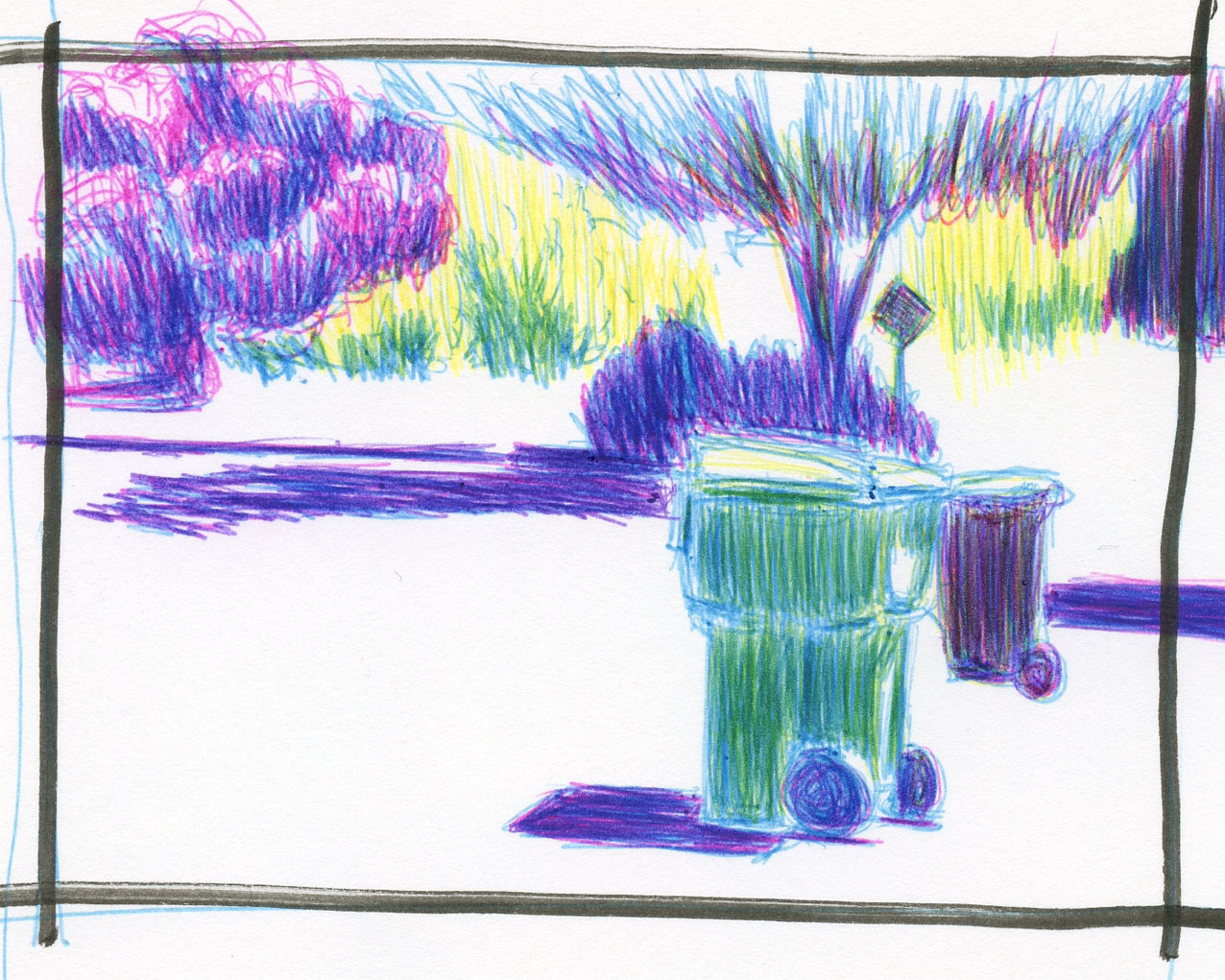
Trapped in the house during our seemingly endless days of hazardous smoke, I made this sketch on a trash day – what an ironic heartbreaker to have to resort to using a reference photo! But I was instantly cheered up when I saw the brilliant mixes I could get from Bic’s version of cyan, magenta and yellow.

Just for fun, I also mixed the three secondary colors that
are included in the two 4-Color assortments shown above.

As much as I enjoy drawing with Bics, I use them mostly for layered tones and, just lately, crosshatching. It’s unlikely that I would use Bics much as a coloring medium. Still, it’s good to know I could use Bics for full color if I wanted to (like on my trips to Gilligan’s Island). And color geek that I am, I was tickled to learn of this potential of Bics that had not occurred to me, despite owning all the colors. (Thank you, Dee, for bringing this to my attention!)


Bic Cristal UPs


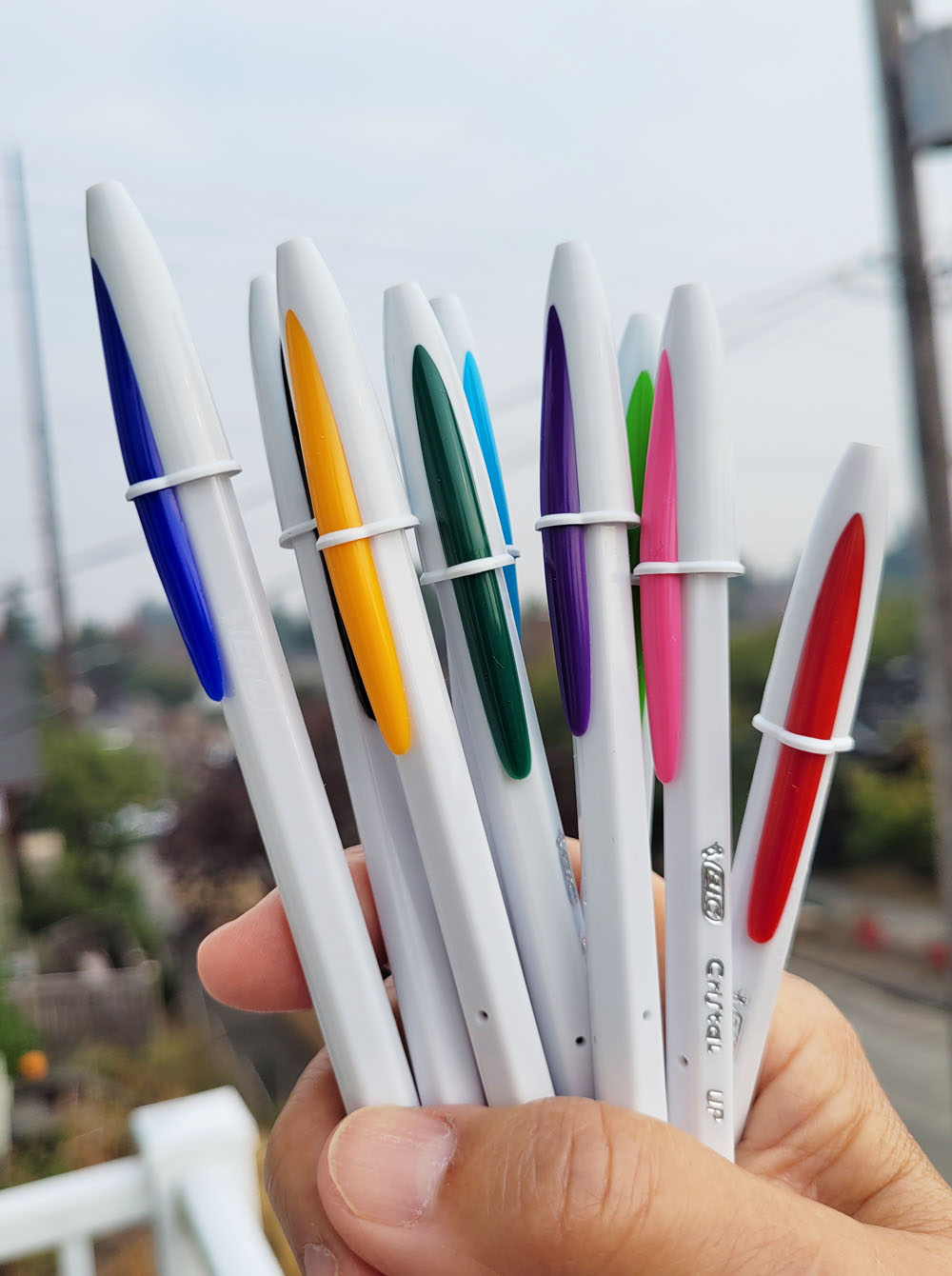
Since Bics are on my mind during InkTober, I’ll also briefly mention one that I learned about from members of the Bic Cristal Facebook group (yes, of course, there’s a Facebook group for that). Because France Van Stone favors “extra bold” 1.6mm Bic Cristals, I had used mine for several exercises in her crosshatching course. I appreciate the bold point that makes crosshatching faster, but the drooly, blobby ink is messy. I eventually switched to my favorite 4-Colors, which have 1mm “medium” points. That’s when I learned about the Bic Cristal UP, which is a separate line of Cristals with a 1.2mm point – just slightly larger than a standard 1mm Cristal and Bic 4-Colors.

I bought a pack, thinking that the Cristal UP might be a nice middle ground between the 1mm and 1.6mm. It is that; and the Cristal UP comes in nine colors (unfortunately, not yellow, or it would be another way to get the CMYK hues). However, its barrel is cheesier than a regular Cristal with a slightly rough texture. The feature I appreciate most about the 4-Color (other than being a multi-pen) is its thicker, more comfortable barrel. I’ll keep using the UPs for InkTober, but I’m not sure the cheesy barrel tradeoff is worth the slightly larger point size. It’s too bad the UP ink cartridges won’t fit into the 4-Color barrels.

Bic Cristal UP: Good point size; cheesy barrel

Sunday, September 4, 2022

More Palms


8/30/22 Maple Leaf neighborhood

I enjoyed sketching palms so much the other day that I think I might go back around to all of the ones on my neighborhood walking route that I’ve sketched previously. Palms are rarely full and symmetrical; they are almost always missing a few fronds, like a gap in a smile. It’s tempting to fill in gaps, but you know me – I’m always “truthful to the scenes I witness.”

By the way, these two palms are next door to the house that is up on stilts, which I sketched a few months ago. The owner is living in the camper in my sketch, and he seems to be doing some of the construction work himself.

Since I sketched the house on stilts, a fence has gone up around the property (at left in my sketch), so I can’t see much of what’s going on at ground level. The door to the upper part has been removed, though, and I can see that the interior has been gutted. I keep walking by with the hope that something sketchable might be happening above the fence level, but nothing so far.

Related Posts Plugin for WordPress, Blogger...